
PLS TOWER and the Case of the Non-Existent Rotational Restraint
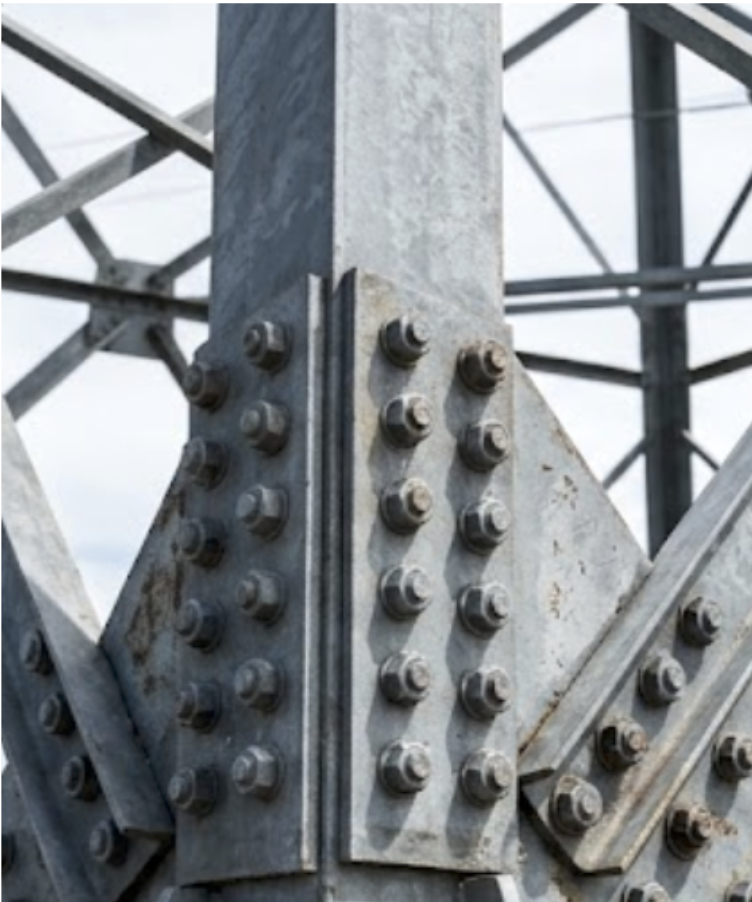
As a visitor to the USA, I’ve frequently found that I really could not understand how ASCE 10 and, by extension, PLS TOWER treatment of the ASCE 10 code would ask, ‘What can restrain a leg?’ To my Cenelec/Eurocode wired brain, I would look at the photograph above and say, ‘itself’. More so, the plates and the bolts in both faces give this connection the very definition of complete rotational restraint.
The BLE Example from PLS TOWER Examples
Here we can see the BLE example from PLS TOWER examples. It’s modelled to ASCE 10, and the End Conditions of the leg are set to 4, or zero rotational restraint.
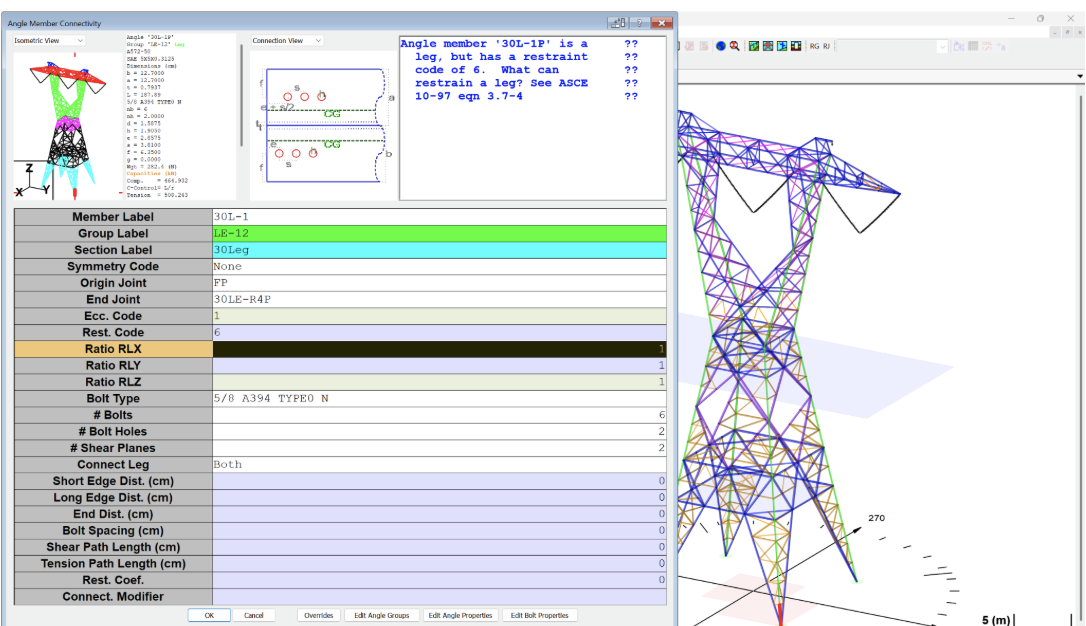
If I were to change the restraint Code to 6 (or 5) for rotational restraint at both ends or rotational restraint at one end, I would get the above warning message.
Angle member '30L-1P' is a leg, but it has a restraint code of 5. What can restrain a leg? See ASCE 10-97 eqn 3.7-4.
Safe across the Atlantic, I just figured I would never have to confront this issue and decided that live and let live was the appropriate response. First it was the Irish, and then it was the Sri Lankans. Because they used ASCE 10 and I worked with them, I now had to deal with this monstrosity.
How PLS TOWER Handles a Leg Member
In PLS-TOWER and under ASCE 10 (Design of Latticed Steel Transmission Structures), a main leg member is evaluated as a compression column. Restraining a leg member effectively reduces its unbraced length (Lx, Ly, or Lz), which lowers its slenderness ratio (L/r) and significantly increases its allowable axial compression capacity before buckling. So a leg, once the intermediate bracings are considered, will have an L/r value of less than 120. Meaning it is a Compact Member.
Now, this is home field knowledge even for my structural brain initially versed with BS5950, BS8100, and EC 3.
I know what a Compact Member is, and I know what that means. The Eccentricity Code will be the ruling case for a Compact Member.
What if a leg member was not a Compact Member? You would get a great big warning which would caution you to guard against the lunacy of adopting a slender member as, effectively, a compression column.
What PLS TOWER (Using ASCE 10) Does with Leg Members to Modify the L/r to Get kL/r
Rotational & End Restraints
ASCE 10 classifies compression member effective lengths (kL/r) based on joint connection details.
Concentric vs. Eccentric Connections: Connections made directly on one leg vs. gusseted connections.
Number of Fasteners/Bolts: Single-bolted connections are treated as unrestrained against rotation (pinned). Multiple-bolted connections or continuous legs through splice joints provide partial end restraint, which lowers the effective length factor k below 1.0 (e.g., using ASCE 10 restraint equations for 120≤L/r≤250). (Compact Members are unaffected by these provisions).
Summary in PLS-TOWER
In PLS-TOWER's Member Table, a leg is restrained whenever you define structural nodes, intersect secondary/redundant braces, or set intermediate unbraced length parameters (Lx,Ly,Lz). The software checks whether attached redundant members meet the required percentage of axial force per ASCE 10 before granting full slenderness reduction. As the leg is a compact member, the provisions for the restraint conditions ruling should never apply.
Am I Resolved That the ASCE 10 Warning Is Correct?
It still doesn’t really make sense to me, as I believe it should never arise, and if it did, it (restraint conditions) would never be the ruling case.
Do I still have concerns over this? Absolutely not!!!
